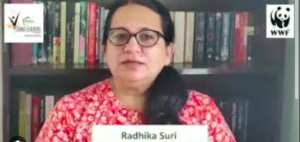
Radhika Suri, an educationist and a storyteller at heart, has been working towards shaping education in India through innovative programmes and policy advocacy for over three decades.
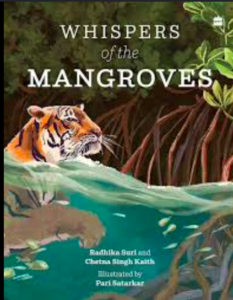
Through her journey as a teacher, education entrepreneur, and eventually, into the non-profit sector, she has applied her domain expertise and pedagogical understanding in the development of educational programs, curriculum frameworks, learning resources, creating learning spaces, and assessment for a diverse range of audiences. Currently, she is the Director of Environment Education at WWF India, where she reshaped the education strategy to expand outreach, improve communication, and deliver successful pilots for state education departments to scale. From urban areas to the remotest areas of India, WWF’s standardized education programs, designed under her leadership, continue to have an impact on the lives of over 500,000 children and youth every year. A true believer in the power of books and stories as teaching tools, she has focused on expanding WWF’s publication repository to include engaging and creative books, guides, manuals and more for teachers, students and youth.
1.Why did you choose to work with an organisation like WWF?
Growing up in Goa, my dad used to ensure I woke up every day before the break of dawn and go with him to the beach to watch the sunrise. I was fascinated with the ants crawling. Our daily routine, rain, hail or sunshine made me understand and respect nature. As an educationist who loves the environment and is passionate about it. WWF was a natural progression and a link between environment and schools, children, colleges and teachers.
- Can you please share a few projects of WWF India?
When I joined WWF, we worked on an education strategy. Environment education was already being taught at schools, but it was not really leading to any significant change. So we worked on a strategy and launched 5 verticals to impact different audiences and use different approaches of education viz.
- Nature Connect Programme- Nature trails and Workshops with adults and children on nature- butterflies, tigers, birding, trees etc. So that people get a better understanding of nature. Celebrating festivals like frog festival, dragonfly festival etc. to generate appreciation and awareness about our bio-diversity.
- People For Planet- Volunteer programme to inspire individuals and organizations across the country to take positive, conservation action for a better planet.
- Tide Turners Plastic Challenge – To inspire young adults to reflect and reduce plastic consumption in association with UNEP.
- Ek-Prithvi- Government school intervention model, to adopt schools across India and work towards making them model Green Schools.
- One-Planet Academy: Digital portal that has wonderful and educative resources on environment, including games and story books.
- .
The latest and quite popular is the Wild Wisdom Challenge started as a quiz in 2020, but given its success, it is going global this year. With 15 countries participating, and in English and Spanish, it is aimed at students across the globe to raise awareness about our rich flora and fauna.
- Lockdown helped revival of nature and wildlife. How can this continue?
It is US. We have seen this during the pandemic, we have worked so well from home, our offices can say please do not come to the office daily, come 2 times a week only. That will keep so many cars off the roads, which will do a world of good to the air. Corporates, apartments, organisations etc. can come up with so many solutions. The pandemic may have been hard, but it is giving us a lot of signals to change. If we listen to those signals, then WOW– there can be magic, and birds can keep chirping and it will be so much fun.
- How can we reduce human-wildlife conflict?
That’s a very tricky one. We work on education on forest ringed schools in Rajaji and Corbett National Parks. It is very interesting, I remember when I first went to forest fringe school it is in the middle of the core. And suddenly there is a tree opening and there is a village right in the middle of nowhere. This is legacy, the British made these villages and they wanted these villagers to plant trees so gave free land to these villagers to stay. But, due to cutting of these trees and reduction of the prey-base, the animals started moving to the village. It is because of this human interference that the human-wildlife conflict exists. The tigers eat your cattle, or a member of the family etc. so there is a lot of anger towards these animals. The villagers also do not get electricity because they are in the core forest. The people in these core areas are deprived of a lot of things by the forest and other departments. So it is a very difficult and complicated situation, for the animals and people, both.
What one can do is (a) protect people, (b) teach them ways of not depending completely on the forest for fuel and food (eg WWF gives bio-gas option to vilagers ) (c) provide alternatives to graze cattle in jungles etc.
I met a couple of children from our education program. These children have gone back to their parents in the villages and told them not to kill tigers. Children do bring a freshness and are good influencers. Education has a huge role to play in solving this complex problem.
- How can children volunteer at WWF?
We do not involve young children too much, as a lot of our core work may be a bit difficult. We do take internships after the age of 18. We offer lot of courses and wokshops that can be engaging and a great way to learn. I did a course on birding with a set of children and this girl Zoya has started a club in her society. I think you all are already working towards this by starting this magazine. So I think you all are already a part of WWF. All you have to do is to keep participating in things, have conversations with us and continue to spread the good word, that’s the most important thing, and that is what you should continue doing.