
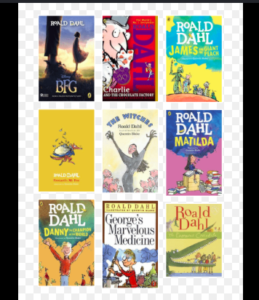
As, the world celebrated the 105th birthday of Roald Dahl on 13th September, we got busy !! Discussions galore about him. Should we feature his books or his movies ? Should we share trivia about him or write about his love for stories? How he broke all rules of English Grammar (sometimes), made us laugh, cry, scream in fear or learn figures of speech !! Our tribute to one of our favourite authors in this week’s special !!
Most of us would have read his books or even watched his movies. Yes, we are talking about Roald Dahl. He had fun with words and his books have a lickwishy taste (for the BFG they taste inky-booky). The words that are not in the dictionary and are made up to make us churgle are called portmanteaus because of these his books are rattwizzlers. He often started with a word that children knew and would change the end to blend in with another word to make it something new, something funny or something atrocious even !!
So let us take a glimpse into the wonderful words of Roald Dahl!!
Argy (verb): If giants or human beans or cattlerpiddlers are argying, they are having an argument.
Catasterous (adjective): A catasterous situation is bad indeed, and a catasterous disastrophe is the worst of all.
Crodsquinkled (adjective): If a giant is crodsquinkled, he is in a hopeless situation.
Flavory-savory (adjective): Sweet and delicious, as fresh walnuts taste to monkeys.
Frumpet (noun): If you call someone a frumpet (not that you would), you mean that they are old and unattractive.
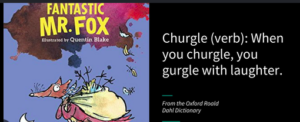
He was exuberantly inventive in the use of the English language What can we learn from him ?
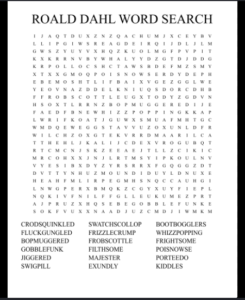
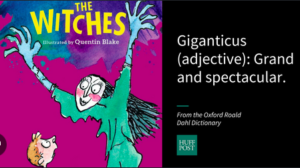
Don’t take language too seriously. The book in which he is at his most linguistically playful is undoubtedly-THE BFG. Language is a central theme in this book. It includes over 300 words that he invented, from ‘biffsquiggled’ to ‘whizzpopping’, in the language known as ‘gobblefunk’.
- Create something new from everyday words. For example, wonderful becomes ‘wondercrump’, and kidnap becomes ‘kidsnatch’. Sometimes he uses common English suffixes like –ful, –some and –wise, to make words like ‘murderful’, ‘rotsome’ and ‘maggotwise’. At other times he adapts the meaning of an everyday word to make an ‘extra-usual’ one. For example, to whoosh means to move very quickly, and he makes this into ‘whooshey’ which describes a very strong smell (as if the scent had whooshed right up your nostrils).
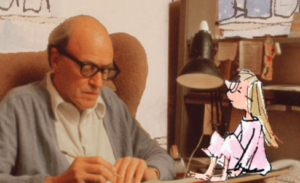
- Consider what’s in a name? Like Dickens, who was one of his favourite authors, Roald Dahl delights in creating names that hint at the nature of his characters, and often his nastiest characters have the funniest names. We get an inkling from his name that greedy Augustus Gloop will come to a sticky end in Charlie and the Chocolate Factory, and that Aunt Spiker in James and the Giant Peachis far from gentle and cuddly. In Matilda, the villainous headmistress Miss Trunchbull’s surname suggests a mixture of truncheon and bull or bully, so fits her perfectly; and the school that she runs, Crunchem Hall, sounds like ‘crunch ’em’, which is what she would like to do to her pupils.
- Have fun with a pun. Roald Dahl loved making jokes from puns or mispronunciations. The BFG uses lots of spoonerisms, which are made by swapping the sounds at the start of two words, so he says ‘catasterous disastrophe’ (for disastrous catastrophe) and ‘jipping and skumping’ (for skipping and jumping). The most elaborate example is one where he brilliantly works his own surname into the mispronunciation ‘Dahl’s Chickens’ (for Charles Dickens), whose books the BFG loves to read.