Sabir Singh Ahuja goes through the history of Netflix and how its decision to become subscription-based altered the course of its history.
You enter your room, slump into your armchair, grab the TV remote, and watch the Netflix opening intro—the N you know so well dividing into a cascade of multicoloured vertical lines that quickly give way to the app. But what you probably don’t know is the story behind those lines. A story of blood, toil, tears and sweat. A story of an evolution from a niche DVD-by-mail service into a global OTT platform whose name is synonymous with entertainment. This is the story behind Netflix.
Wilmot Reed Hastings Jr was born on 8 October 1960, into an intellectual and financially successful family in Boston, Massachusetts. He blossomed into a fine young man, with a good sense of moral values. Having graduated with a master’s in computer science from Stanford, he, backed by his family’s wealth, could choose whichever path he wished. In 1991, he founded Pure Software, a software tools company. It expanded quickly, doubling revenue every year for four consecutive years. In 1996, it merged with Atria Software to form Pure Atria Corporation. Later the same year, Pure Atria acquired Integrity QA, an automated software testing and quality assurance company. This is when Hastings met the founder of Integrity QA, Marc Randolph. He had become the head of marketing for Pure Atria, working closely with Hastings. About their first meeting, Randolph described Hastings as having “unbelievable capacity, and range of curiosity, and ways to create ideas and assimilate them in different ways”. Then, in August 1997, Rational Software acquired Pure Atria—a deal that gave Hastings the capital he would soon use to start Netflix. On 29 August, they founded Netflix in Scotts Valley, California. The next year, in 1998, they launched Netflix.com, with only 925 titles at the time.
In September 1999, Reed Hastings made a revolutionary decision. One that would make Netflix what it is today. He made Netflix a subscription-based rental service. Gone were the days when people would have to pay to rent every single DVD. That was inconvenient for both the company and the customers. Now, they would pay a fixed sum of money every month, and could borrow as many DVDs as they wanted, without late fees. This would create a continuous revenue influx. However, they continued to suffer heavy losses, and by 2000, were willing to quit. They went to the rental giant, Blockbuster, and offered to sell them their company. The Blockbuster CEO, John Antioco, however, rejected them, viewing Netflix as a “joke”. Later that year, they launched CineMatch, a recommendation algorithm. In 2002, Netflix decided to finally go public on the NASDAQ, opening at 15 per share and raising approximately 82.5 million. This gave them the necessary capital to increase the scale of their operations and inventory further. Their comeback had thus begun. In 2003, Netflix reached its first million subscribers. By 2006, the subscriber base had grown to 5 million. In 2007, they made the biggest decision since the subscription model. They officially launched their streaming service, fundamentally disrupting the very industry Blockbuster continued to dominate with physical retail.
Netflix’s business was booming. In 2010, the once-monopolistic Blockbuster filed for bankruptcy, finally beaten by the “joke” they’d rejected. A major factor was Netflix’s customer loyalty built from the monthly subscription model. Following a massive database corruption in 2008, Netflix began migrating its entire operation to Amazon Web Services (AWS). This allowed for massive global scalability.
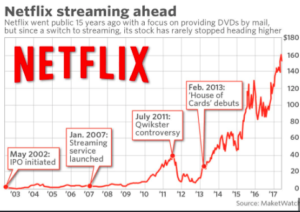
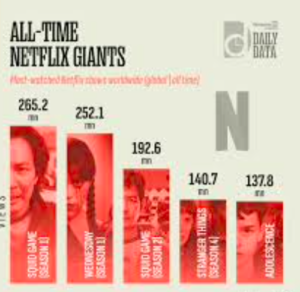
In 2013, Netflix showed the world it was not just a content distributor—it was a content producer, releasing its first major original, House of Cards. This was not a random move. It, like everything else Netflix had done, was calculated. This was at a time when the cultural phenomenon of binge-watching had newly been discovered. By releasing entire seasons at once, Netflix began to pioneer it. By 2015, they had expanded into 50 countries, while investing in big data to understand regional and social preferences. This led to major shows like the Spanish Money Heist and the South Korean Squid Game, which are now immensely popular worldwide.
Now, Netflix has expanded into live events (like WWE Raw) and even gaming (like the Stranger Things game). For the fiscal year of 2025, they either met or exceeded all their financial objectives, making a total revenue of $45.2B. Today, Netflix remains the global market leader with over 325 million paid memberships.