

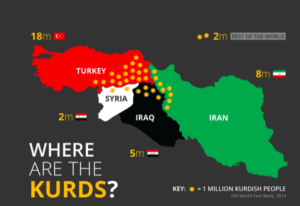
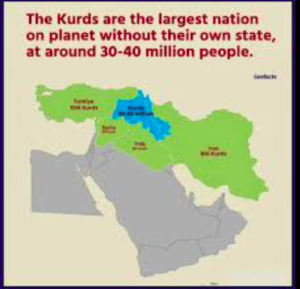
Kurds or the Kurdish are an ancient ethnic group, with deep roots to Mesopotamia and indigenous to Turkiye in the South east, Iran in the North west and Syria in the North east with a population of approximately 40-45 million. Their rich language, culture and oral history of literature and poetry can be traced back to roots in the Zagros mountains dating back 2500-5000 years or even the Medes- the early Iranians. The term “Kurd” became popular after the 7th century, to describe the tribes of the region after the Arab conquest.
A stateless nation inspite of their autonomy as a regional group, their hope for Kurdish nationalism and independence has remained a piped dream since the early days of the Ottoman Empire. The Ottoman empire collapsed post World War I, the allied powers rejected a planned homeland. The 1920 Treaty of Sèvres, was replaced by the 1923 Treaty of Lausanne, which cemented the current borders. Their displacement across newly formed states of Turkey, Syria and Iraq, has been a mute testimony to the ethnic and political tension in West Asia since the 19th century. The nationalist movement for autonomy, termed “mutinous” got suppressed across the four nations of Iran (Rojelat), Iraq(Bashur), Turkey(Bakur) and Syria(Rojava) and their diaspora being fragmented across the region leading to ongoing struggles and conflicts.
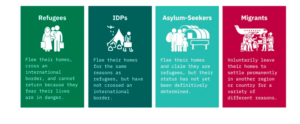
What is the key difference between IDP’s and refugees?
- IDP’s or Internally Displaced People are those who have been forcibly removed but manage to continue living in their country or nation.
- Refugees on the other hand migrate or cross international borders and seek refuge in another country.
- An IDP becomes a refugee once they cross the International border.
United Nations Human Rights Council believes an estimated 16 million people have been displaced from Syria and Iraq due to civil war and sectarian violence. About 2 million refugees and internally displaced persons (IDPs) have escaped their home towns and countries, and found solace in Iraqi Kurdistan. According to the Kurdistan Regional Government (KRG), refugees and IDPs now represent 28% of the Iraqi Kurdistan’s total population.
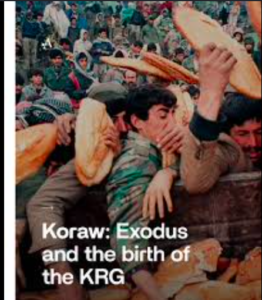
From the late 1970’s, Saddam Hussein’s government forcibly pushed hundreds of thousands of Kurds, destroyed about 4,000 of their villages, sprayed 200 odd villages with biological and chemical weapons (WMD) and carried a genocide that displaced 668,000 Kurds displaced to the north. Iraqi security forces continue occupying those coveted and oil rich lands after the widespread destruction of the villages with approximately 3500 odd landmines in a 900 square kms area. Amongst the ill-fated legacies Saddam Hussein left, are the one million plus people who remain forcibly exiled, the Kurds—Iraq’s largest minority—and part of the Shi’ite majority, particularly the Marsh Arabs and Shi’ite opponents of the regime. The plight highlights the unfair abandonment and lack of sanitation, land grabbing for oil reserves, absence of civic rights, their ethnicity and religion in question , citizenship, national allegiance, and systems of justice.
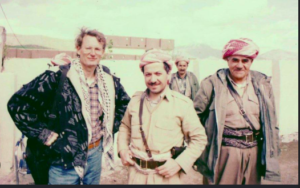
Over the past decade, a united front of Kurdish Regional Government has been functioning, although not unequivocally, in the north under the security guarantee of the United States by aiding them to begin regularised and systematic de-mining, rebuild the countryside by helping them with farming and occupation to enable them to return, resettle and reclaim their displaced cities. Such steps require the cooperation of the two main Kurdish political groups, Masud Barzani’s Kurdish Democratic Party and Jalal Talabani’s Patriotic Union of Kurdistan. Infighting from 1994-1997 and lack of a cohesive voice amongst the Kurdish factions has forcibly uprooted more than 100,000 people who have sought refuge and asylum in the neighbouring states. Most are yet to return home as they feel uncertain about the longevity of such a deal.
With the Hormuz of Strait closed and the NATO and its other allies not supporting them, they have began to arm and weaponize the Kurdish militias along the Iran-Iraq border. The US Military are aggressively pushing them to take the fight over the border into Iran and be the foot soldiers, who eventually shall become just a number on the statistics.The Kurdish movement unfortunately has been unable to garner international attention, with no representative in the United Nations, they have been pushed pillar to post to find a State that can take its case without any ulterior motive. The Kurds simple demand of human dignity and the right to live and be recognised is something that transcends political borders and interests.
“To deny people their human rights is to challenge their very humanity.” — Nelson Mandela