

Census is not just a population count. It reflects demographic trends, the distribution spread between rural and urban areas, outlines demographic structure, to help governments plan policies and allows citizens to claim their rights.
India with a long, tumultuous and vivid history of civilisation have had rulers from different parts of the world across its pages of history. Knowing the land and its people was an essential component to extend their rule in the territory, different kinds of surveys were undertaken at different time periods with varied objectives from resource collection to territory extension. The East India company, more concrete in their colonial spirit decided that a general population census would be conducted and thus was born the modern census 1872.
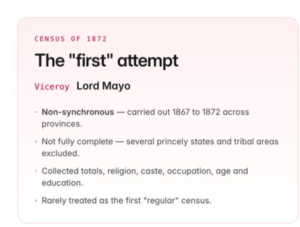
Since then decennially, the census has seen marked changes with the time-specific demand from the administration and policy-makers who are highly dependent on the data to design the policy. Centennial celebrations after the 1971 census, gave the demographic variables its modern shape. There was an elaboration on migration by adding information on birth place and place of last residence. The 1991 census showcased technological interface and data dissemination. The schedule was expanded to collect the information on household amenities, type of cooking fuel used and availability of toilet facilities for rural areas., information on ex-servicemen and their status as pensioners and non-pensioners.
2001, was the first census in this century, keeping pace with modernisation in every aspect of its deliberations. 2011 was the last census, 2021 pandemic pushed the census meanwhile in the span of 15 years, India’s data on demographics, housing conditions and welfare amenities have become obsolete or outdated. The mammoth task of collating data across a billion plus people is no easy feat. The census will also include caste enumeration for the first time by approximately 03 million officials, over a year spanning 28 states and eight union territories (federally run territories), which include more than 7,000 towns and 640,000 villages detailing household composition, living conditions and access to basic amenities.
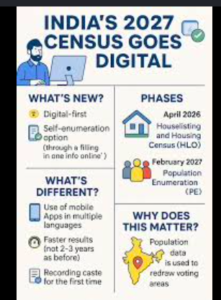
The first digital census, it will use tools like mobile applications to collect and submit data through 33 questions. Individuals have the option to self-enumerate through an online portal, receive a unique digital ID, to be submitted to the officials collecting data from 22nd April onwards, concluding on 31st March 2027. Experts state, this has left significant data gaps. Ashwini Deshpande, an economist at Ashoka University, argued the census matters beyond what it directly measures. “Since it is a full enumeration of the entire population, all large-scale surveys – which, by design, capture only a subset of households – rely on the census as their sampling frame.” With India’s last census now well over a decade old, every major survey conducted in this period is working off a frame that no longer reflects the population it is meant to represent. That is not a minor technical inconvenience. It introduces systematic errors into the data that policymakers, researchers and planners depend on, a lack of information on India’s demographics at a time of rapid economic and political changes.”
India’s latest census has been mired in controversy with the government’s delimitation exercise, basically redrawing the boundaries of electoral constituencies based on population. Politicians in southern India, feel with growth being stagnant, delimitation if based on population size, northern India, will get a major share of the pie. The bulk of representation in the Indian Parliament already comes from the north, and has been a source of north-south conflict that shall just deepen the chasm further. Further, the women’s reservation bill of last year along with the delimitation would make for one-third reservation in the parliament. This year, questions on couples’ relationship status have also been included. Couples in a live-in relationship will be counted as married “if they consider their relationship as a stable union”, according to the census portal.
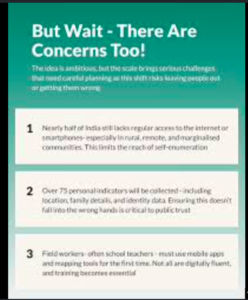
Addition of caste inventory after not so gentle nudges from campaigners and caste groups, make this a deeply contested exercise-the first systematic, population-wide count of jati [caste] since 1931. Those in favour believe this will enable allocation of resources, opportunities across caste hierarchy, nor any policies be designed with any precision. Meanwhile, those at odds believe this will entrench irreversible divisions, by cataloguing every subcaste, lending caste a bureaucratic legitimacy that deepens and polarises.

The 2027 Census with Pragati and Vikas as its mascot should indeed be about Progress and Growth. “India teaches me again and again, that the categories into which I try to divide things don’t hold up.” — Dena Moes