
The debate around artificial intelligence has evolved dramatically over the past few years. What began as conversations about automation and machine learning has now entered a new phase centered on AI agents—intelligent digital systems capable of performing complex tasks, making decisions, coordinating workflows, and increasingly functioning as virtual employees. As organizations across the world race to integrate these technologies into their operations, questions about the future of employment have become more urgent than ever.
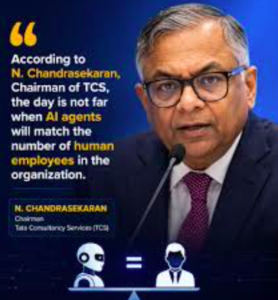
A significant contribution to this discussion recently came from Tata Consultancy Services Chairman N. Chandrasekaran, who offered a remarkably optimistic view of AI’s impact on business and society. Rather than seeing artificial intelligence as a threat to employment, he described it as the most significant opportunity the technology services industry has encountered. His vision is ambitious. According to him, TCS could have as many AI agents as human employees within the next three years. Even more striking is his prediction that by 2030, every dollar of TCS revenue will contain an AI component. These statements reflect not just a corporate strategy but a broader shift in how major enterprises are thinking about the future of work.
For many people, such predictions immediately raise concerns about job losses. If AI agents become capable of performing tasks traditionally handled by humans, what happens to millions of workers who currently occupy those roles? The concern is understandable. Throughout history, technological revolutions have disrupted labor markets, replacing certain jobs while creating new opportunities. The arrival of AI agents appears poised to trigger a similar transformation, but at a speed and scale rarely seen before.
Chandrasekaran argues that the growth of AI should not be viewed through the narrow lens of replacement. Instead, he believes AI agents will work alongside human employees, dramatically increasing productivity and enabling businesses to undertake projects that were previously too expensive or time-consuming. In this vision, AI becomes a force multiplier rather than a substitute for human talent. Employees will not disappear; they will evolve into supervisors, designers, strategists, and managers of increasingly sophisticated digital workforces.
The economic rationale behind this optimism is compelling. As intelligence becomes cheaper and more accessible through AI, businesses are likely to spend more on technology rather than less. Companies that have delayed modernization efforts due to cost constraints may suddenly find large-scale digital transformation projects financially viable. Legacy systems that have remained untouched for decades can be upgraded more rapidly. Complex business processes can be redesigned. Customer experiences can be personalized at scale. Entire industries may become more efficient and innovative as a result.
Evidence of this trend is already visible. TCS has reported annualized AI-related revenue of approximately $2.5 billion, a figure that has doubled compared to the previous year while continuing to grow rapidly. Such numbers suggest that AI is no longer an experimental technology being tested in isolated departments. It is becoming a core driver of business growth and competitive advantage. Organizations that successfully integrate AI into their operations may gain substantial productivity benefits, creating pressure on competitors to follow suit.
Yet the benefits of AI do not eliminate the challenges it poses. One of the most immediate consequences is likely to be a reduction in traditional large-scale hiring, particularly at the entry level. For decades, technology companies built their workforces by recruiting thousands of graduates every year to perform routine coding, testing, maintenance, support, and administrative tasks. These roles served as the foundation of professional careers, allowing young workers to gain experience and gradually move into more advanced positions. If AI agents become capable of handling much of this routine work, companies may no longer require the same volume of fresh hires.

This possibility creates a difficult question for the future workforce. If entry-level opportunities shrink significantly, how will the next generation acquire the experience needed to become senior professionals? The traditional career ladder may become less accessible, forcing educational institutions and employers to rethink how talent is developed. Future graduates may need stronger practical skills from the outset, while organizations may need to design entirely new pathways for workforce development.
Another concern involves the widening gap between high-skilled and low-skilled workers. AI tends to excel at routine, predictable tasks, whether they involve processing data, generating reports, writing basic code, or answering standard customer inquiries. Workers whose jobs rely heavily on such activities may face increasing pressure as automation becomes more capable. At the same time, demand is likely to grow for individuals who can design, manage, govern, and improve AI systems. This could lead to a labor market where highly specialized professionals enjoy expanding opportunities while workers with outdated skills struggle to remain competitive.
The challenge of continuous learning therefore becomes central to the future of employment. In previous generations, individuals could rely on a degree or professional qualification for much of their careers. The AI era may require a different mindset. Skills could become obsolete more quickly, forcing workers to adapt continuously. Technical knowledge, data literacy, critical thinking, creativity, and the ability to collaborate effectively with intelligent systems may become essential attributes rather than optional advantages.

Beyond employment numbers, AI agents also raise important questions about governance and accountability. Chandrasekaran has suggested that governing intelligence may become the new annuity business for IT services companies. As organizations deploy thousands or even millions of AI agents across critical operations, managing those systems will become a major responsibility. Businesses will need experts capable of ensuring compliance with regulations, protecting sensitive data, monitoring performance, addressing ethical concerns, and maintaining trust. In this environment, the value of institutional knowledge, industry expertise, and long-standing client relationships could increase significantly.
This perspective may explain why established firms believe they are well positioned for the AI era. While newer companies often excel at building innovative technologies, large enterprises possess deep understanding of customer environments, regulatory frameworks, operational complexities, and risk management requirements. As AI systems become more deeply integrated into critical business functions, trust and governance may become as important as technological capability itself.
The broader social implications of widespread AI adoption remain uncertain. Optimists envision a future in which productivity gains generate economic growth, higher living standards, and entirely new categories of employment. Pessimists worry about job displacement, wage stagnation, and growing inequality. The reality will likely contain elements of both. History suggests that technological progress ultimately creates more opportunities than it destroys, but the transition periods can be painful for workers whose skills no longer match market demands.
What seems increasingly clear is that the future of employment will not be defined by a simple competition between humans and machines. The more realistic scenario is one of collaboration, where human workers and AI agents operate together in interconnected teams. AI may handle repetitive analysis, routine execution, and information processing, while humans focus on judgment, creativity, leadership, empathy, and strategic decision-making. The organizations that thrive will be those capable of combining the strengths of both.
The vision presented by TCS reflects a future that is arriving faster than many anticipated. A world in which AI agents rival human employees in number is no longer science fiction. It is becoming a strategic objective for some of the world’s largest companies. Whether this transformation ultimately benefits society will depend not only on technological innovation but also on how governments, businesses, educational institutions, and workers adapt to the new reality. The age of AI agents has begun, and the choices made today will shape the employment landscape for decades to come.