

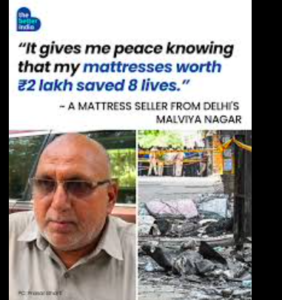
There are moments that cut right through the noise of everyday life — moments that remind you what human beings are actually capable of when it matters most. June 3, 2026, was one of those moments. And at the centre of it wasn’t a trained firefighter, a government official, or a headline-chasing hero. It was Riyazuddin Mansuri — a 60-something mattress trader from Hauz Rani in Malviya Nagar, South Delhi — a man who had simply shown up to work, like he had every single day for the past 45 years.
That morning started like any other. Riyazuddin unlocked his shop, his son Armaan by his side, and settled into the familiar rhythm of a Tuesday. Forty-five years of early mornings, stacked inventory, the smell of cotton and foam, and the quiet predictability of a life built around honest trade. He had no reason to expect anything different. He was wrong.
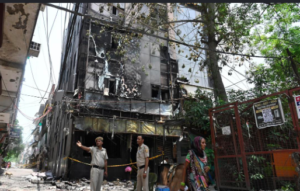
Across the street, the Flourish Stay hotel caught fire. Panic-stricken guests trapped on the upper floors smashed windows and desperately called for help.  The blaze moved fast. Smoke poured out. People were running out of time and out of options. The fire ultimately claimed 21 lives. 
But Riyazuddin didn’t freeze. He didn’t wait for someone else to do something. As cries for help grew louder, he knew every second mattered. Without stopping to think about the risks or the cost, he and Armaan rushed into their shop and began pulling out mattresses and quilts.  Father and son, working with urgency and purpose, spread around 20 to 25 mattresses and quilts on the road, creating a makeshift safety cushion for guests forced to jump from the burning building. 
It was not a sophisticated plan. It was not the product of training or protocol. It was just a man looking at a crisis and asking himself: what do I have, and what can I do? He had mattresses. He used them.
As the fire spread through the building, trapped guests began jumping to escape the smoke. The pile of mattresses broke their fall, turning a stretch of concrete into a makeshift lifeline. Nearly eight people survived after landing on the cushion created by Riyazuddin and Armaan. 
The cost? Many of the mattresses used during the operation were damaged, causing losses estimated at around ₹2 lakh.  Two lakhs. Gone. Just like that — not stolen, not lost to bad business, but willingly sacrificed in the span of a few frantic minutes. For a small shop owner, that is not a minor setback. That is months of margin, years of careful saving, inventory built piece by piece. And yet, the family appeared unfazed by the financial setback, choosing instead to focus on those who survived. 
When asked about it afterward, Riyazuddin kept it simple. “When I saw people trapped, I took out the mattresses. Saving lives was more important,” he told reporters. “Allah gave me the responsibility to save lives,”  he said. No performance. No calculation. Just a man at peace with what he chose to do.
Recognising his bravery, local authorities and community members later honoured Mansuri with a financial reward of ₹1 lakh  — half of what he lost. Many felt that wasn’t nearly enough, and honestly, they’re right. But Riyazuddin Mansuri doesn’t seem like someone who did it for the reward.
There is something quietly profound about the image of this man and his son dragging mattress after mattress out of a small shop and laying them down on a burning street. No cameras set up in advance. No audience waiting to applaud. Just a father, a son, and a decision made in real time — the right one.
We talk a lot about healing the world as if it requires grand gestures, sweeping policy, or viral movements. But sometimes it looks like this: a 45-year veteran of ordinary life, on an ordinary Tuesday, doing something extraordinary because the moment asked him to. Riyazuddin Mansuri didn’t save the world. He saved eight people in it. And right now, that feels like exactly enough.