

Why the Universe May Be Deadlier Than We Think?
The Dark Forest Theory is a deeply unsettling experiment, which tries to answer the Fermi Paradox: if the universe was vast and billions of years old, why haven’t we found evidences of alien civilisation? This term was coined by the Chinese author Cixin Liu in his 2008 novel, called the dark forest. This theory suggests the reason for the cosmos silence:
Everyone is hiding, because the universe is inherently hostile.
The Fermi Paradox is an unsettling contradiction between the extraordinarily high mathematical probability that outsider life exists and the absolute lack of evidence that it does. This theory heavily depends on the exorbitant scale of the cosmos. 1. Billions of stars: there are roughly 100-400 Billion stars in the Milky Way Galaxy alone, and roughly 2 trillion galaxies in the observable universe. 2. Billions of Earths: Current estimates suggest that there could be as many as 40 billion Earth-sized planets orbiting the ‘habitable zone’ of sun-like stars and red-dwarfs within our galaxy. 3. Deep Time: The universe is 13.8 Billion years old, meanwhile, our Solar System is only 4.5 Billion Years old. Which means that there could be signs of life, even before our solar system existed.
So why, given these staggering odds, is the universe so eerily quiet?
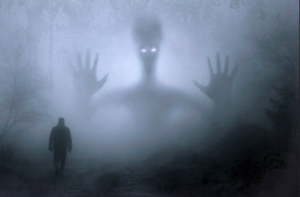
Liu’s answer is as elegant as it is chilling. Imagine yourself walking alone through a vast, dark forest at night. You can hear rustling in the shadows — something is out there. Do you call out and announce your presence? Or do you stay silent, move carefully, and hope nothing finds you first? According to the Dark Forest Theory, every civilisation in the universe faces exactly this dilemma. And the rational choice, always, is silence.
The theory rests on two core assumptions about the nature of life itself. First, that survival is the primary drive of every civilisation — much like it is for every living creature on Earth. Second, that resources in the universe are fundamentally finite. Stars burn out. Planets are limited. Energy is not infinite. When two civilisations with unlimited growth ambitions eventually collide in a universe of limited resources, conflict becomes not just possible, but mathematically inevitable.
Here is where the theory takes its darkest turn. Because communication across interstellar distances takes thousands of years, and because there is no reliable way to verify another civilisation’s intentions, trust becomes impossible to establish. A civilisation that appears peaceful today could develop into an existential threat centuries from now. Given those odds, Liu argues, the only logical response upon detecting another civilisation is to eliminate it — swiftly and without hesitation — before it can do the same to you.
This brutal logic, the theory suggests, explains the silence perfectly. The universe is not empty. It is full of hunters, all holding their breath.
The implications of this theory extend well beyond science fiction. In 2016, a team of astronomers detected a powerful radio signal — dubbed the “Wow! Signal’s modern cousin” — originating from a sun-like star 94 light-years away. Debates erupted immediately: should humanity respond? Stephen Hawking, among others, issued stark warnings against broadcasting our location into space, arguing that contact with a more advanced civilisation could spell catastrophe for our species — much as it did for indigenous peoples when European explorers arrived on their shores.It is a sobering analogy. Throughout human history, encounters between technologically unequal civilisations have rarely ended well for the lesser-developed one.
Why should the cosmos be any different?
Of course, the Dark Forest Theory is not without its critics. Many scientists argue that it projects human psychological traits — fear, aggression, resource competition — onto civilisations we know nothing about. An advanced civilisation, some contend, may have long transcended the survival instincts that drive conflict here on Earth.
Others point to the very existence of SETI — the Search for Extraterrestrial Intelligence — as a counterargument. If the Dark Forest logic were universal, no civilisation would ever risk sending detectable signals. And yet, some anomalies remain unexplained.
Perhaps the most unsettling truth is this: we have already been broadcasting our presence for over a century through television signals, radio waves, and radar. If the Dark Forest is real, we may have already lit a fire in the darkness — and something, somewhere, may already be watching the smoke.